
Pureline Commercial RO Systems (Standard Series)
Standard Reverse Osmosis Systems with Integrated Pretreatment
PureLine Commercial Reverse Osmosis (RO) Systems are engineered to deliver reliable and efficient water purification for a wide range of commercial and industrial applications. Designed with integrated pre-treatment solutions, these systems help ensure stable operation, consistent permeate quality, and reduced membrane fouling for reliable long-term performance.
Suitable for a diverse range of industries, including data centres and critical infrastructure, semiconductor and electronics manufacturing, hospitality, food & beverage, healthcare, laboratories, agriculture, and industrial and process manufacturing.
Key Features & Benefits
- RFully assembled and tested in Malaysia
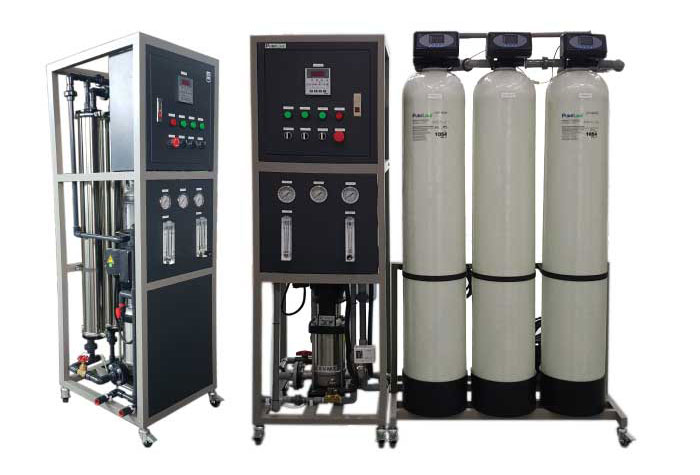
- RIntegrated pre-treatment systems for improved RO performance and membrane protection
- RSkid-mounted design for ease of installation and mobility
- RAvailable with stainless steel or powder-coated carbon steel frames
- RPlug-and-play installation
- RExpandable and customisable system configurations
- REasy access design for maintenance and servicing
- RDesigned for efficient operation and low maintenance requirements
- RIndividual system testing prior to delivery
- R1-year limited warranty
System Capacity
Available in capacities ranging from 1,500 to 12,000 GPD, designed to accommodate varying water demand requirements for commercial and industrial applications.
System Benefits
PureLine Commercial RO Systems are designed to deliver:
- NStable and consistent water quality
- NLong-term system reliability for continuous operation
- NEfficient and reliable system operation
- NReliable protection of downstream processes and equipment
- NReduced downtime through an easy-access maintenance design
Applications
- Data Centres & Critical Infrastructure
- Hotels & Hospitality
- Agriculture & Farming Operations
- Semiconductor & Electronics Manufacturing
- Healthcare & Medical Facilities
- Industrial & Process Manufacturing
- Food & Beverage Processing
- Laboratories & Research Facilities
- Commercial Buildings & Facilities
System Configuration
Each PureLine Commercial Reverse Osmosis (RO) System can be configured with:
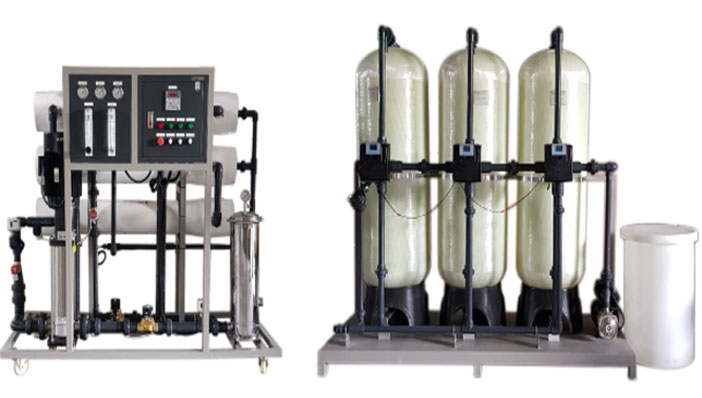
- NPre-Treatment: Integrated or customised pre-treatment systems, including Multimedia Filters (MMF), Activated Carbon Filters (ACF), Water Softening Filtration ( WSF ) and Antiscalant Dosing Systems, where required.
- NHigh-performance RO membranes, including Halal-certified RO membrane options
- NRO high-pressure pumps and associated system components
- NAutomatic control and monitoring systems, based on system requirements
Quick Guide: What Each Treatment Removes
| Treatment | Main Purpose | TDS / Dissolved Salts | Chlorine | Chloride | Hardness | Suspended Solids | Bacteria / Microorganisms |
|---|---|---|---|---|---|---|---|
| Multimedia Filter (MMF) | Particle & turbidity removal | No | No | No | No | Yes | Limited |
| Activated Carbon Filter (ACF) | Chlorine & organic reduction | No | Yes | No | No | Limited | Limited |
| Water Softener | Hardness reduction | No significant reduction | No | No | Yes | No | No |
| Ultrafiltration (UF) | Fine particle & microorganism removal | No | No | No | No | Yes | Yes / significant reduction |
| Reverse Osmosis (RO) | Dissolved contaminant removal | Yes | Yes* | Yes | Yes | Yes | Yes / significant rejection |
| Deionisation (DI) | Ionic purity / polishing | Yes** | No | Yes** | Yes** | No | No |
| UV Steriliser | Microbiological disinfection | No | No | No | No | No | Yes / inactivation |
FAQ
Pureline Commercial RO Systems
What industries commonly use commercial RO systems?
Commercial RO systems are commonly used in:
- Hospitality
- Food & beverage
- Agriculture
- Laundries
- Restaurants
- Commercial buildings
- Light industrial applications
Reverse Osmosis (RO) Systems - Understanding Reverse Osmosis
What is Reverse Osmosis (RO)?
Reverse Osmosis (RO) is a membrane-based water purification process that uses pressure to force water through a semi-permeable membrane.
The RO membrane allows water molecules to pass through while rejecting a high percentage of dissolved salts, minerals, and other contaminants.
The RO process produces two main water streams:
- Permeate (Product Water): The purified water that passes through the RO membrane.
- Reject (Concentrate) Water: The water containing a higher concentration of rejected dissolved contaminants that does not pass through the membrane.
What does an RO system remove from water?
RO membranes can remove or significantly reduce a wide range of dissolved and suspended contaminants, including:
- Dissolved salts and minerals
- TDS (Total Dissolved Solids)
- Chloride ions
- Sodium
- Calcium
- Magnesium
- Sulphates
- Nitrates
- Fluoride
- Many heavy metals
- Bacteria and microorganisms
- Other dissolved impurities
The actual removal rate depends on the RO membrane type, feed water quality, operating pressure, temperature, recovery, and system condition.
Does RO remove TDS?
Yes. One of the main purposes of an RO system is to reduce dissolved salts and minerals, which results in a significant reduction in TDS.
For example, if feed water contains 500 mg/L of TDS and the RO membrane achieves 98% salt rejection, the resulting permeate TDS may theoretically be around 10 mg/L, subject to actual operating conditions.
Does RO remove chloride?
Yes. RO membranes can effectively reject chloride ions (Cl⁻) because chloride is a dissolved ion. The amount removed depends on the membrane’s salt rejection performance and operating conditions.
It is important to distinguish between chlorine and chloride:
- Chlorine: A disinfectant and oxidising agent that can damage certain RO membranes. It is commonly removed using an activated carbon filter before the RO system.
- Chloride: A dissolved salt ion that is primarily reduced by the RO membrane.
Therefore, activated carbon and RO perform different functions and are often used together in an RO pretreatment system.
Does RO remove 100% of TDS and salts?
No. RO membranes do not normally remove 100% of dissolved salts. A small amount of dissolved ions may pass through the membrane.
The percentage of salts rejected is known as the salt rejection rate. A typical brackish water RO membrane may achieve approximately 95–99% salt rejection under suitable operating conditions, although actual performance varies depending on membrane type and operating conditions.
Does RO remove hardness?
Yes. RO can significantly reduce hardness by rejecting dissolved calcium and magnesium ions.
However, for feed water with high hardness or high scaling potential, pretreatment such as water softening or anti-scalant dosing may still be required to protect the RO membrane.
Does RO remove bacteria and viruses?
RO membranes can effectively reject many bacteria, viruses, and other microorganisms due to their very fine membrane structure. However, RO systems should not automatically be considered a complete disinfection system.
For applications requiring a high level of microbiological control, additional treatment such as UV sterilisation or other disinfection methods may be recommended.
Why is pre-treatment important for RO systems?
Proper pretreatment helps protect RO membranes from:
- Suspended solids and turbidity
- Particulate fouling
- Organic fouling
- Chlorine oxidation
- Hardness scaling
- Other contaminants that can reduce membrane performance
Depending on the feed water quality, pretreatment may include multimedia filtration, activated carbon filtration, water softening, anti-scalant dosing, cartridge filtration, or UF.
What is RO recovery?
RO recovery is the percentage of feed water converted into permeate or product water.
For example, if an RO system receives 10 m³/hr of feed water and produces 7.5 m³/hr of permeate, the recovery is 75%. The remaining 2.5 m³/hr is reject or concentrate water.
RO recovery must be carefully designed based on feed water chemistry and scaling potential. Higher recovery is not always better, as concentrating dissolved salts in the reject stream can increase the risk of membrane scaling.