
Pureline Industrial RO Systems (High-Capacity Series)
Industrial , Process & Specialised Water Treatment Applications
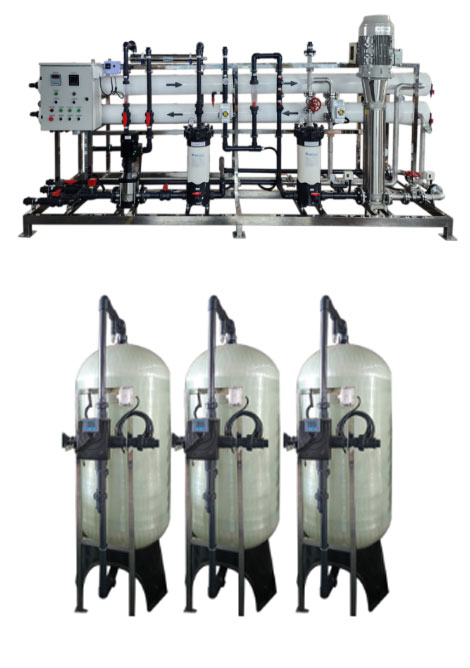
PureLine Industrial Reverse Osmosis (RO) Systems are high-capacity water purification systems engineered for demanding industrial, commercial, and specialised water treatment applications. Designed to accommodate higher flow rates, stringent water quality requirements, and continuous-duty operation, these systems provide reliable performance and long-term operational stability.
Our Industrial RO Systems are engineered according to specific project requirements, including feed water characteristics, required flow rates, recovery targets, and treated water quality objectives. Systems can be configured with suitable pre-treatment and post-treatment processes to optimise RO performance, protect membranes, and achieve the required water quality.
Available in capacities above 12,000 GPD , PureLine Industrial RO Systems can be supplied as skid-mounted, containerised, or customised systems, depending on project requirements and site conditions.
.
Key Features & Benefits
- RHigh-capacity industrial-grade RO system design
- RDesigned for continuous-duty operation in demanding applications
- RIntegrated or customised pre-treatment systems
- RSkid-mounted or containerised system configurations
- REngineered for stable performance under varying feed water conditions
- RHigh-performance RO membrane systems for consistent permeate quality
- RReduced fouling potential and extended RO membrane service life
- RDesigned for reliable operation and reduced downtime
- RCustomisable system configuration based on project requirements
- RFlexible integration with existing water treatment infrastructure
- RSuitable for industrial process, water reuse, boiler feed water, and desalination applications
Technical Highlights
- RCapacity: Above 12,000 GPD
- RSystem Type: Industrial skid-mounted, containerised, or customised RO system
- RPre-Treatment: Integrated or customised pre-treatment systems, including Multimedia Filters (MMF), Activated Carbon Filters (ACF), Water Softening Filtration ( WSF ) and Antiscalant Dosing Systems, where required.
- RRO Configuration: Single-pass, double-pass, or seawater RO (SWRO), depending on application requirements
- ROperation: Continuous-duty industrial operation
- RApplication: Industrial, process, water reuse, boiler feed water, and seawater desalination
Applications
- Industrial Process Water Treatment
- Electronics & Semiconductor Manufacturing
- Sewerage Wastewater Reclamation & Water Reuse
- Containerised & Portable Water Treatment Systems
- Rural & Remote Water Supply
- Boiler Feed Water Treatment
- High-Pressure Boiler Feed Water Treatment
- Double-Pass RO for High-Purity Water Applications
- Palm Oil Mills and Industrial Facilities
- Seawater Desalination for Island Resorts and Coastal Facilities
- Manufacturing Industries
- Food & Beverage Production Facilities
- Chemical and Process Industries
- Power Plants and Utilities
- Data Centres & Critical Infrastructure
- Large-Scale Commercial Facilities
Selected Project Applications
Our experience includes the design and supply of RO systems for a variety of industrial, commercial, and specialised water treatment requirements, including:
1. Rural & Remote Water Supply
Containerised RO systems with integrated pre-treatment supplied for rural and remote areas in East Malaysia, providing a practical and deployable water treatment solution for locations where conventional water treatment infrastructure may be limited. The containerised design enables efficient transportation, installation, and deployment in remote locations.
2. Electronics Manufacturing Facilities
RO water treatment systems supplied for electronics manufacturing applications, supporting water treatment requirements in advanced manufacturing environments.
3. Sewerage Wastewater Reclamation
RO systems with integrated pre-treatment for treated sewerage wastewater reclamation and water reuse applications.
4. Containerised & Portable RO Systems
Containerised RO systems with integrated pre-treatment, designed for flexible deployment and applications requiring portable or relocatable water treatment solutions.
5. Boiler Feed Water Treatment
Complete RO systems with pre-treatment for boiler feed water applications, including systems supplied for palm oil mill operations.
6. High-Pressure Boiler Feed Water
Double-pass RO systems designed to produce higher-quality permeate for demanding high-pressure boiler feed water applications.
7. Seawater Desalination
Seawater Reverse Osmosis (SWRO) systems for desalination and reliable water supply applications, including island resorts and coastal facilities.
System Engineering Advantage
PureLine Industrial RO Systems are engineered for reliability, scalability, and long-term operational efficiency. Each system is designed according to the specific feed water quality, required flow rate, recovery target, permeate quality, and process requirements.
Our flexible system configurations allow for the integration of appropriate pre-treatment and post-treatment processes, including multimedia filtration, activated carbon filtration, water softening, chemical dosing, double-pass RO, and other treatment technologies where required.
The modular design enables flexible installation, future system expansion, and seamless integration with existing water treatment infrastructure. Depending on project requirements, systems can be supplied as skid-mounted, containerised, or fully customised solutions.
With experience across industrial water treatment, electronics manufacturing, rural and remote water supply, wastewater reclamation, boiler feed water, high-purity water production, and seawater desalination, PureLine Industrial RO Systems provide engineered solutions for demanding water treatment applications
Quick Guide: What Each Treatment Removes
| Treatment | Main Purpose | TDS / Dissolved Salts | Chlorine | Chloride | Hardness | Suspended Solids | Bacteria / Microorganisms |
|---|---|---|---|---|---|---|---|
| Multimedia Filter (MMF) | Particle & turbidity removal | No | No | No | No | Yes | Limited |
| Activated Carbon Filter (ACF) | Chlorine & organic reduction | No | Yes | No | No | Limited | Limited |
| Water Softener | Hardness reduction | No significant reduction | No | No | Yes | No | No |
| Ultrafiltration (UF) | Fine particle & microorganism removal | No | No | No | No | Yes | Yes / significant reduction |
| Reverse Osmosis (RO) | Dissolved contaminant removal | Yes | Yes* | Yes | Yes | Yes | Yes / significant rejection |
| Deionisation (DI) | Ionic purity / polishing | Yes** | No | Yes** | Yes** | No | No |
| UV Steriliser | Microbiological disinfection | No | No | No | No | No | Yes / inactivation |
FAQ
Pureline Industrial RO Systems
What is the benefit of industrial RO systems?
Industrial RO systems provide high-capacity purified water production for demanding industrial processes and continuous operation environments.
They can be engineered with suitable pretreatment, membrane configurations, instrumentation, controls, and automation based on the required flow rate and water quality.
Can ASD design systems for high flow rate requirements?
Yes. Industrial RO systems can be engineered according to required feed and permeate flow rates, recovery rates, feed water chemistry, product water quality targets, operating conditions, and site requirements.
Reverse Osmosis (RO) Systems - Understanding Reverse Osmosis
What is Reverse Osmosis (RO)?
Reverse Osmosis (RO) is a membrane-based water purification process that uses pressure to force water through a semi-permeable membrane.
The RO membrane allows water molecules to pass through while rejecting a high percentage of dissolved salts, minerals, and other contaminants.
The RO process produces two main water streams:
- Permeate (Product Water): The purified water that passes through the RO membrane.
- Reject (Concentrate) Water: The water containing a higher concentration of rejected dissolved contaminants that does not pass through the membrane.
What does an RO system remove from water?
RO membranes can remove or significantly reduce a wide range of dissolved and suspended contaminants, including:
- Dissolved salts and minerals
- TDS (Total Dissolved Solids)
- Chloride ions
- Sodium
- Calcium
- Magnesium
- Sulphates
- Nitrates
- Fluoride
- Many heavy metals
- Bacteria and microorganisms
- Other dissolved impurities
The actual removal rate depends on the RO membrane type, feed water quality, operating pressure, temperature, recovery, and system condition.
Does RO remove TDS?
Yes. One of the main purposes of an RO system is to reduce dissolved salts and minerals, which results in a significant reduction in TDS.
For example, if feed water contains 500 mg/L of TDS and the RO membrane achieves 98% salt rejection, the resulting permeate TDS may theoretically be around 10 mg/L, subject to actual operating conditions.
Does RO remove chloride?
Yes. RO membranes can effectively reject chloride ions (Cl⁻) because chloride is a dissolved ion. The amount removed depends on the membrane’s salt rejection performance and operating conditions.
It is important to distinguish between chlorine and chloride:
- Chlorine: A disinfectant and oxidising agent that can damage certain RO membranes. It is commonly removed using an activated carbon filter before the RO system.
- Chloride: A dissolved salt ion that is primarily reduced by the RO membrane.
Therefore, activated carbon and RO perform different functions and are often used together in an RO pretreatment system.
Does RO remove 100% of TDS and salts?
No. RO membranes do not normally remove 100% of dissolved salts. A small amount of dissolved ions may pass through the membrane.
The percentage of salts rejected is known as the salt rejection rate. A typical brackish water RO membrane may achieve approximately 95–99% salt rejection under suitable operating conditions, although actual performance varies depending on membrane type and operating conditions.
Does RO remove hardness?
Yes. RO can significantly reduce hardness by rejecting dissolved calcium and magnesium ions.
However, for feed water with high hardness or high scaling potential, pretreatment such as water softening or anti-scalant dosing may still be required to protect the RO membrane.
Does RO remove bacteria and viruses?
RO membranes can effectively reject many bacteria, viruses, and other microorganisms due to their very fine membrane structure. However, RO systems should not automatically be considered a complete disinfection system.
For applications requiring a high level of microbiological control, additional treatment such as UV sterilisation or other disinfection methods may be recommended.
Why is pre-treatment important for RO systems?
Proper pretreatment helps protect RO membranes from:
- Suspended solids and turbidity
- Particulate fouling
- Organic fouling
- Chlorine oxidation
- Hardness scaling
- Other contaminants that can reduce membrane performance
Depending on the feed water quality, pretreatment may include multimedia filtration, activated carbon filtration, water softening, anti-scalant dosing, cartridge filtration, or UF.
What is RO recovery?
RO recovery is the percentage of feed water converted into permeate or product water.
For example, if an RO system receives 10 m³/hr of feed water and produces 7.5 m³/hr of permeate, the recovery is 75%. The remaining 2.5 m³/hr is reject or concentrate water.
RO recovery must be carefully designed based on feed water chemistry and scaling potential. Higher recovery is not always better, as concentrating dissolved salts in the reject stream can increase the risk of membrane scaling.
How often do RO membranes require cleaning?
Cleaning frequency depends on feed water quality, pretreatment performance, operating conditions, recovery rate, and membrane fouling or scaling tendencies.
Proper pretreatment, routine monitoring, and preventive maintenance can help extend the operating period between membrane cleanings.