
PureLine Post Treatment & RO Support Systems
Water Polishing, High-Purity Water , Disinfection & System Lifecycle Solutions
PureLine Post-Treatment and RO Support Systems are designed to enhance treated water quality, provide final polishing and disinfection, and support the long-term performance and reliability of Reverse Osmosis (RO) systems.
Our solutions include RODI systems, deionisation systems, UV water disinfection, and RO membrane cleaning and maintenance services, providing comprehensive treatment and support throughout the water treatment system lifecycle.
Engineered for reliable performance and consistent water quality, our post-treatment and RO support solutions are suitable for a wide range of industrial, commercial, and specialised water treatment applications.
RODI Systems
High-Purity Water for Industrial Process Applications
RODI (Reverse Osmosis Deionised Water) systems combine Reverse Osmosis (RO) and Deionisation (DI) technologies to produce high-purity water for industrial and process applications requiring low conductivity and reduced dissolved ionic contaminants.
The RO process removes the majority of dissolved solids and contaminants, while the subsequent deionisation stage further removes residual ions to achieve higher water purity.
Our PureLine RODI systems can be configured according to specific feed water quality and product water requirements and are suitable for a range of industrial manufacturing applications.
Selected Application:
RODI systems supplied for hand glove manufacturing applications, supporting process water requirements where consistent high-purity water quality is required.
Post-Treatment / Polishing Systems
1. Twin Bed Deionisation Systems
Demineralisation & Industrial Process Applications
Twin Bed Deionisation systems are designed for the effective removal of dissolved ions to produce demineralised and high-purity water for industrial and commercial applications.
The system utilises separate cation and anion exchange vessels to remove dissolved ionic contaminants from treated water. Depending on the system configuration, the ion exchange resins can be regenerated to support continued operation.
Engineered for reliable ion exchange performance, efficient regeneration, and stable operation, Twin Bed DI systems provide an effective solution for applications requiring demineralised or high-purity water.
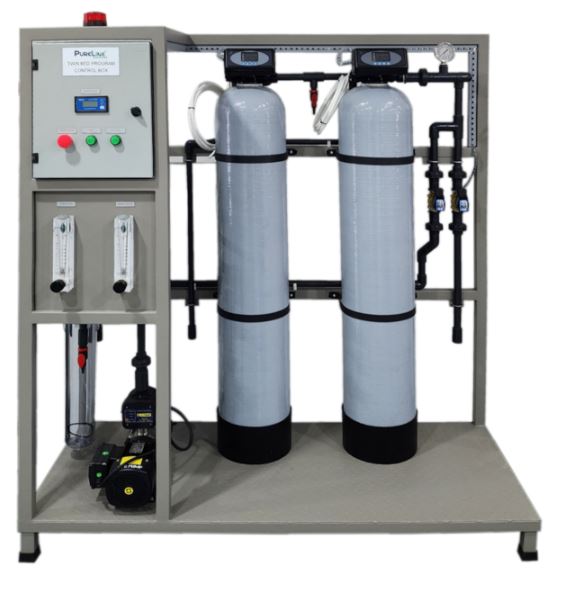
Post-Treatment / Polishing Systems
2. Mixed Bed Deionisation Systems
High Purity Water Polishing Applications
Mixed Bed Deionisation (DI) systems are designed for the final polishing of treated water to achieve very high purity levels and low conductivity. These systems are typically used as a final treatment stage for applications requiring high-purity water and stringent water quality requirements.
By combining cation and anion exchange resins in a single vessel, our PureLine Mixed Bed DI systems effectively remove residual dissolved ions from treated water and produce high-quality polished water.
Engineered for high-performance ion exchange and consistent treated water quality, our Mixed Bed DI systems are suitable for precision applications requiring high-purity water.
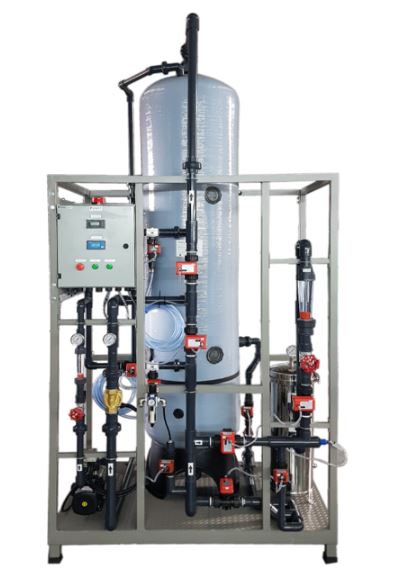
Post-Treatment / Polishing Systems
3. UV Water Sterilizer Systems
Disinfection & Final Treatment Applications
Ultraviolet (UV) water disinfection systems provide effective microbial inactivation without the addition of chemical disinfectants. UV treatment is commonly used as a final treatment stage to help control microorganisms and maintain consistent microbiological water quality.
Our UV systems are engineered for reliable disinfection performance, consistent UV dosage, and low-maintenance operation, making them suitable for a wide range of industrial and commercial water treatment applications.
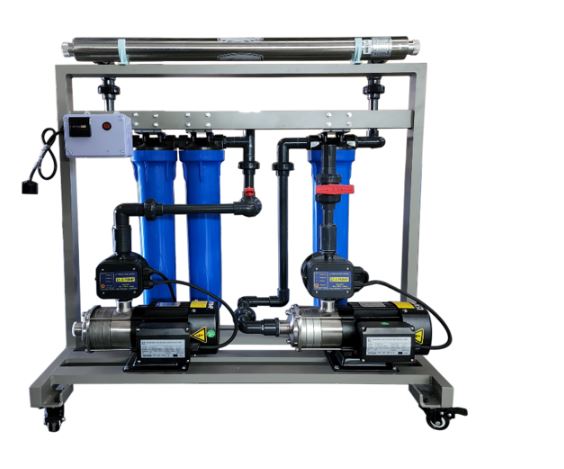
RO Support & Auxiliary Systems
CIP (Clean-In-Place) Systems & RO Membrane Cleaning Services
Membrane Cleaning & Maintenance Solutions
CIP (Clean-In-Place) systems are designed for the effective cleaning and maintenance of Reverse Osmosis (RO) membranes, helping to remove accumulated fouling and restore membrane performance.
Regular membrane cleaning can help maintain stable permeate flow, optimize system recovery, reduce fouling-related performance losses, and extend RO membrane service life.
ASD also provides RO membrane CIP cleaning and technical service support, including system assessment, chemical cleaning, chemical circulation, membrane cleaning, and operational troubleshooting to help maintain optimal RO system performance.
Engineered for controlled and effective cleaning operations without dismantling individual membrane elements, our CIP solutions and services support the long-term reliability and operational efficiency of RO systems.
Quick Guide: What Each Treatment Removes
| Treatment | Main Purpose | TDS / Dissolved Salts | Chlorine | Chloride | Hardness | Suspended Solids | Bacteria / Microorganisms |
|---|---|---|---|---|---|---|---|
| Multimedia Filter (MMF) | Particle & turbidity removal | No | No | No | No | Yes | Limited |
| Activated Carbon Filter (ACF) | Chlorine & organic reduction | No | Yes | No | No | Limited | Limited |
| Water Softener | Hardness reduction | No significant reduction | No | No | Yes | No | No |
| Ultrafiltration (UF) | Fine particle & microorganism removal | No | No | No | No | Yes | Yes / significant reduction |
| Reverse Osmosis (RO) | Dissolved contaminant removal | Yes | Yes* | Yes | Yes | Yes | Yes / significant rejection |
| Deionisation (DI) | Ionic purity / polishing | Yes** | No | Yes** | Yes** | No | No |
| UV Steriliser | Microbiological disinfection | No | No | No | No | No | Yes / inactivation |
FAQ
Deionisation (DI) Systems
What is Deionised (DI) Water?
Deionised water is water that has had most dissolved ions removed through an ion exchange process using specialised cation and anion resins.
DI systems are commonly used when very low ionic content or high-purity water is required.
What is the difference between Twin Bed and Mixed Bed DI systems?
Twin Bed DI systems use separate cation and anion resin vessels to remove positively and negatively charged ions.
Mixed Bed DI systems combine cation and anion resins in a single vessel. They are commonly used for final polishing to achieve higher-purity water.
What applications require deionised water?
DI water is commonly used in:
- Electronics manufacturing
- Semiconductor applications
- Laboratories
- Pharmaceuticals
- Boiler feed water
- Precision manufacturing
- Other high-purity water applications
UV Water Steriliser Systems
How does UV sterilisation work?
UV water sterilisation uses ultraviolet light to deactivate bacteria, viruses, and other microorganisms by damaging their genetic material, preventing them from reproducing.
UV treatment is a physical disinfection process and does not require chemical addition.
Does UV treatment remove TDS or dissolved salts?
No. UV treatment does not remove TDS, dissolved salts, chloride, hardness, or other dissolved contaminants.
UV is primarily used for microbiological disinfection and is often used as a final treatment or polishing step after processes such as RO or filtration.
Does UV treatment affect water taste or odour?
UV treatment generally does not change the taste, odour, or mineral composition of water because it does not add chemicals or remove dissolved minerals.
CIP (Clean-In-Place) Systems
What is a CIP system?
A Clean-In-Place (CIP) system is designed to clean RO membranes by circulating specialised cleaning solutions through the membrane system without removing the membrane elements from their housings.
Why is membrane cleaning important?
Over time, RO membranes may experience fouling or scaling due to contaminants in the feed water.
Routine membrane cleaning can help:
- Restore permeate flow
- Reduce differential pressure
- Improve membrane performance
- Control fouling and scaling
- Maintain stable system operation
- Extend membrane service life
When should an RO membrane be cleaned?
RO membranes should generally be cleaned when there is a significant decline in normalised permeate flow, an increase in differential pressure, or a deterioration in salt rejection, provided these changes are not caused by other system issues.
Cleaning frequency depends on feed water quality and system operating conditions.
Does ASD provide RO membrane cleaning services?
Yes. ASD provides CIP service support, including chemical cleaning, troubleshooting, operational checks, and membrane performance recovery assistance.