
PureLine Industrial RO Pretreatment Systems
Industrial Water Treatment Support Solutions
PureLine Industrial RO Pretreatment Systems are designed to ensure stable and efficient operation of downstream water treatment systems. These solutions play a critical role in protecting RO membranes, improving water quality, and optimising overall system performance in industrial and commercial applications.
Our range includes filtration, softening, advanced membrane pre-treatment, and chemical dosing systems, all engineered for reliability, operational stability, and long-term efficiency.
Pre-Treatment Systems
1. Water Filtration Systems
Pre-Treatment & Process Applications
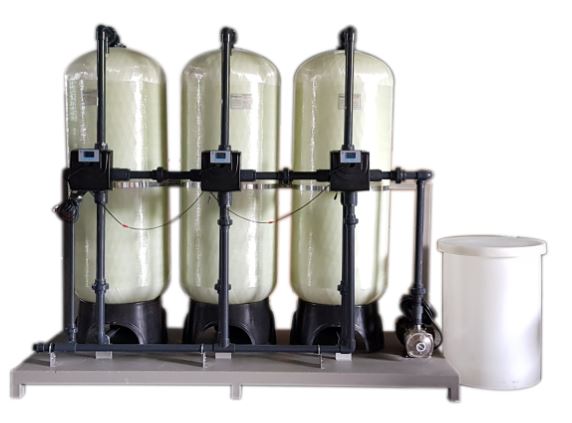
Multimedia Filters (MMF) and Activated Carbon Filters (ACF) are commonly used as effective pre-treatment solutions for Reverse Osmosis (RO) systems. For instance, MMF helps reduce the risk of fouling and maintain a lower Silt Density Index (SDI) for downstream RO membranes, while ACF helps remove chlorine and other oxidising agents, protecting RO membranes from oxidation damage.
These filtration systems utilise multiple layers of media with varying densities and particle sizes to enhance filtration performance. The multi-layer filtration process enables deeper filtration, higher contaminant loading capacity, and longer operating cycles.
Our PureLine Multimedia Filters (MMF) and Activated Carbon Filters (ACF) are available with automatic timer-controlled backwash or manual valve backwash options. Systems can also be supplied with frontal piping skids for ease of installation, operation, and maintenance.
Engineered for reliable performance, efficient solids and contaminant removal, and consistent water quality, our filtration systems are suitable for a wide range of industrial and commercial water treatment applications.
Pre-Treatment Systems
2. Water Softening Systems
Hardness Removal & Protection Applications
Ion exchange water softening systems are designed to effectively reduce hardness-causing minerals, such as calcium and magnesium, in water, helping to protect downstream equipment and Reverse Osmosis (RO) systems from scaling in industrial and commercial applications.
Our PureLine Water Softening Filtration (WSF) systems are available with automatic timer-controlled regeneration or manual valve operation options. Systems can also be supplied with frontal piping skids for ease of installation, operation, and maintenance.
Engineered for efficient ion exchange performance, stable operation, and long-term system reliability, our water softening systems provide effective hardness reduction and reliable protection for downstream water treatment equipment.
Pretreatment Systems
3. Ultrafiltration (UF) Systems
Fine Filtration & Pre-Treatment Applications
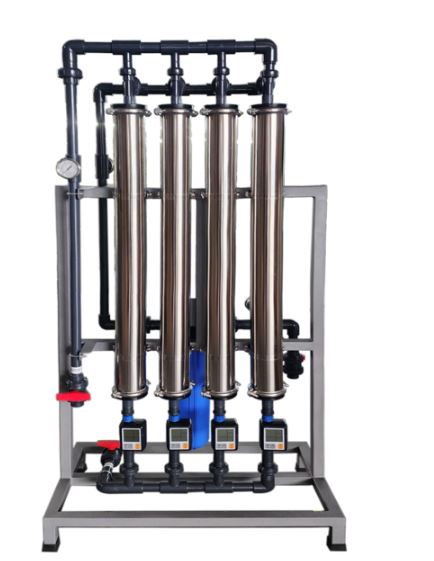
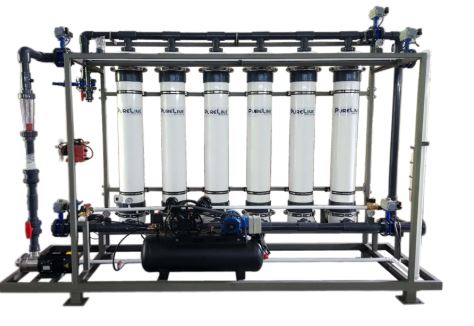
Ultrafiltration (UF) is a low-pressure-driven membrane separation process that effectively removes suspended solids, colloidal substances, and other particulate contaminants from feed water. With typical membrane pore sizes ranging from 0.01 to 0.10 µm, UF systems provide high removal efficiency for turbidity, colloids, and fine particles, making them suitable for a wide range of water treatment and pre-treatment applications.
Our PureLine Ultrafiltration (UF) Systems are supplied as skid-mounted systems for ease of installation, operation, and maintenance.
Engineered for consistent filtration performance, high contaminant removal, and stable operation, our UF systems are suitable for continuous-use applications across a wide range of industrial and commercial water treatment processes.
Chemical & Process Systems
Chemical Dosing Systems
Process Control & Water Treatment Applications
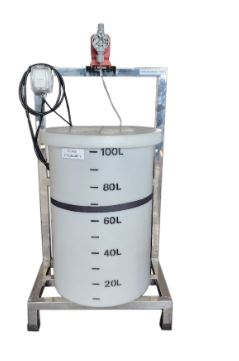
Chemical dosing systems are designed for the precise and controlled injection of treatment chemicals in water and wastewater applications, including pH adjustment, disinfection, antiscalant dosing, and process optimization.
Antiscalants and scale inhibitors are chemicals added to feed water upstream of an RO system to help reduce the potential for scale formation on RO membranes, supporting stable system performance and extending membrane service life.
Our chemical dosing systems are available in manual or automatic control configurations and can be supplied with dosing pumps, chemical solution tanks, and integrated control panels based on specific system requirements.
Engineered for accurate chemical dosing, operational stability, and reliable process control, our dosing systems are suitable for a wide range of industrial and commercial water and wastewater treatment applications.
FAQ
General Water Treatment Systems
What industries are ASD water treatment systems suitable for?
ASD water treatment systems are suitable for a wide range of industrial and commercial applications, including semiconductor and electronics manufacturing, data centres, manufacturing, food & beverage, hospitality, healthcare, agriculture, laboratories, and other process industries where reliable, high-quality water treatment is essential.
Can ASD water treatment systems be customized based on application requirements?
Yes. Our water treatment systems can be engineered and customized according to specific feed water quality, required flow rate, operating conditions, water quality targets, space limitations, and application requirements. We assess the water source and treatment objectives to develop a suitable and reliable treatment solution.
Are your water treatment systems suitable for continuous operation?
Yes. Our systems can be designed for stable and continuous operation, using durable components and reliable process controls suitable for industrial and commercial environments. System configuration depends on the required operating hours, flow rate, water quality, and redundancy requirements.
How do I know which water treatment system I need?
The appropriate treatment system depends on the quality of your incoming water and the required quality of the treated water. Factors such as TDS, hardness, turbidity, iron, manganese, chlorine, organic contaminants, bacteria, and other water parameters should be considered.
A water analysis is recommended before selecting a treatment system. Based on the water quality and application requirements, different treatment technologies such as multimedia filtration, activated carbon filtration, water softening, ultrafiltration (UF), reverse osmosis (RO), deionisation (DI), and UV sterilisation may be used individually or in combination.
Pre-Treatment Systems - Water Filtration Systems
What is the purpose of a Multimedia Filter (MMF)?
MMFA Multimedia Filter (MMF) is commonly used as a pre-treatment system to remove suspended solids, turbidity, and particulate matter from water. It typically uses multiple layers of filtration media with different densities and particle sizes to improve filtration performance.
MMF helps reduce the Silt Density Index (SDI) and the amount of suspended matter entering downstream treatment equipment. This can help reduce fouling and protect sensitive equipment such as RO membranes.
The exact removal performance depends on the filter media, system design, flow rate, and incoming water quality. An MMF is generally not designed to remove dissolved salts or significantly reduce TDS.
What contaminants does a Multimedia Filter remove?
A Multimedia Filter is primarily designed to reduce:
- Suspended solids
- Turbidity
- Sand and particulate matter
- Larger physical impurities
It is generally not designed to remove dissolved salts, chloride, or TDS. Additional treatment, such as RO, may be required to remove dissolved contaminants.
Why is an Activated Carbon Filter (ACF) used?
Activated Carbon Filters (ACF) use adsorption to reduce chlorine, odour, colour, and certain organic contaminants in water.
ACF is commonly installed before RO systems because free chlorine can damage the polyamide membrane layer used in many RO membranes. Removing chlorine before the RO membrane helps protect the membrane from oxidation damage and premature degradation.
Does activated carbon remove chloride from water?
No. Activated carbon is primarily used to remove free chlorine, not chloride ions (Cl⁻).
This is an important distinction:
- Chlorine (Cl₂ / free chlorine) – commonly removed by activated carbon
- Chloride (Cl⁻) – a dissolved ion that is primarily reduced by RO or other desalination processes
Therefore, an activated carbon filter is often used before RO to remove chlorine and protect the RO membrane, while the RO membrane itself is responsible for rejecting most dissolved salts, including chloride.
Do your filtration systems come with automatic backwash?
Yes. Filtration systems can be supplied with automatic timer-controlled backwash or manual valve operation, depending on the application, system configuration, and budget requirements.
Pre-Treatment Systems - Water Softening Systems
What does a water softener do?
A water softener reduces water hardness by removing hardness-forming ions, primarily calcium (Ca²⁺) and magnesium (Mg²⁺), through an ion exchange process.
The calcium and magnesium ions are exchanged with sodium ions or other non-scale-forming ions. This helps reduce the potential for scale formation in downstream equipment.
Does a water softener remove TDS?
A water softener does not significantly reduce TDS. In fact, the ion exchange process replaces calcium and magnesium ions with other ions, so the overall TDS may remain similar or may not decrease significantly.
If the objective is to reduce TDS or dissolved salts, technologies such as Reverse Osmosis (RO) or Deionisation (DI) may be required.
Why is water softening important before RO systems?
Reducing water hardness helps minimise the risk of scale formation on RO membranes. This can help maintain stable RO performance, reduce cleaning frequency, and extend membrane service life.
Depending on the feed water quality, a water softener may be used as part of RO pretreatment. In other applications, an anti-scalant dosing system may be used instead or in combination with other pretreatment methods.
Are regeneration processes automatic?
Yes. Water softening systems can be supplied with automatic timer-controlled regeneration or manual operation configurations.
During regeneration, the softener resin is restored using a concentrated salt solution, commonly known as brine.
Pre-Treatment Systems - Ultrafiltration (UF) Systems
What is Ultrafiltration (UF)?
Ultrafiltration (UF) is a membrane filtration process that uses a very fine membrane barrier to separate suspended solids and high molecular weight contaminants from water.
UF membranes have much larger pores than RO membranes and generally operate at lower pressure.
What contaminants can Ultrafiltration remove?
UF systems can effectively remove or reduce:
- Suspended solids
- Fine particles
- Turbidity
- Colloids
- Bacteria
- Some microorganisms
- High molecular weight contaminants
UF does not normally remove dissolved salts, chloride, or TDS effectively because these substances are much smaller than the UF membrane pores.
Is UF suitable as pretreatment for RO systems?
Yes. UF is commonly used as a pretreatment technology for RO systems, particularly when the feed water contains high levels of suspended solids, colloids, or microorganisms.
By improving the quality of RO feed water, UF can help reduce membrane fouling and improve the stability of downstream RO operation.
Chemical & Process Systems - Chemical Dosing Systems
What chemicals can be dosed using your systems?
Our chemical dosing systems can be designed for various water treatment applications, including:
- Anti-scalant dosing
- pH adjustment
- Chlorination
- Dechlorination
- Coagulation
- Disinfection
- Other process chemical dosing applications
For example, anti-scalant chemicals may be injected into the RO feed water to help control the formation of sparingly soluble salts such as calcium carbonate (CaCO₃), calcium sulphate (CaSO₄), and barium sulphate (BaSO₄). This helps reduce scaling risk and maintain stable RO membrane performance.
Can dosing systems operate automatically?
Are chemical dosing systems supplied complete?
Reverse Osmosis (RO) Systems - Understanding Reverse Osmosis
What is Reverse Osmosis (RO)?
Reverse Osmosis (RO) is a membrane-based water purification process that uses pressure to force water through a semi-permeable membrane.
The RO membrane allows water molecules to pass through while rejecting a high percentage of dissolved salts, minerals, and other contaminants.
The RO process produces two main water streams:
- Permeate (Product Water): The purified water that passes through the RO membrane.
- Reject (Concentrate) Water: The water containing a higher concentration of rejected dissolved contaminants that does not pass through the membrane.
What does an RO system remove from water?
RO membranes can remove or significantly reduce a wide range of dissolved and suspended contaminants, including:
- Dissolved salts and minerals
- TDS (Total Dissolved Solids)
- Chloride ions
- Sodium
- Calcium
- Magnesium
- Sulphates
- Nitrates
- Fluoride
- Many heavy metals
- Bacteria and microorganisms
- Other dissolved impurities
The actual removal rate depends on the RO membrane type, feed water quality, operating pressure, temperature, recovery, and system condition.
Does RO remove TDS?
Yes. One of the main purposes of an RO system is to reduce dissolved salts and minerals, which results in a significant reduction in TDS.
For example, if feed water contains 500 mg/L of TDS and the RO membrane achieves 98% salt rejection, the resulting permeate TDS may theoretically be around 10 mg/L, subject to actual operating conditions.
Does RO remove chloride?
Yes. RO membranes can effectively reject chloride ions (Cl⁻) because chloride is a dissolved ion. The amount removed depends on the membrane’s salt rejection performance and operating conditions.
It is important to distinguish between chlorine and chloride:
- Chlorine: A disinfectant and oxidising agent that can damage certain RO membranes. It is commonly removed using an activated carbon filter before the RO system.
- Chloride: A dissolved salt ion that is primarily reduced by the RO membrane.
Therefore, activated carbon and RO perform different functions and are often used together in an RO pretreatment system.
Does RO remove 100% of TDS and salts?
No. RO membranes do not normally remove 100% of dissolved salts. A small amount of dissolved ions may pass through the membrane.
The percentage of salts rejected is known as the salt rejection rate. A typical brackish water RO membrane may achieve approximately 95–99% salt rejection under suitable operating conditions, although actual performance varies depending on membrane type and operating conditions.
Does RO remove hardness?
Yes. RO can significantly reduce hardness by rejecting dissolved calcium and magnesium ions.
However, for feed water with high hardness or high scaling potential, pretreatment such as water softening or anti-scalant dosing may still be required to protect the RO membrane.
Does RO remove bacteria and viruses?
RO membranes can effectively reject many bacteria, viruses, and other microorganisms due to their very fine membrane structure. However, RO systems should not automatically be considered a complete disinfection system.
For applications requiring a high level of microbiological control, additional treatment such as UV sterilisation or other disinfection methods may be recommended.
Why is pre-treatment important for RO systems?
Proper pretreatment helps protect RO membranes from:
- Suspended solids and turbidity
- Particulate fouling
- Organic fouling
- Chlorine oxidation
- Hardness scaling
- Other contaminants that can reduce membrane performance
Depending on the feed water quality, pretreatment may include multimedia filtration, activated carbon filtration, water softening, anti-scalant dosing, cartridge filtration, or UF.
What is RO recovery?
RO recovery is the percentage of feed water converted into permeate or product water.
For example, if an RO system receives 10 m³/hr of feed water and produces 7.5 m³/hr of permeate, the recovery is 75%. The remaining 2.5 m³/hr is reject or concentrate water.
RO recovery must be carefully designed based on feed water chemistry and scaling potential. Higher recovery is not always better, as concentrating dissolved salts in the reject stream can increase the risk of membrane scaling.